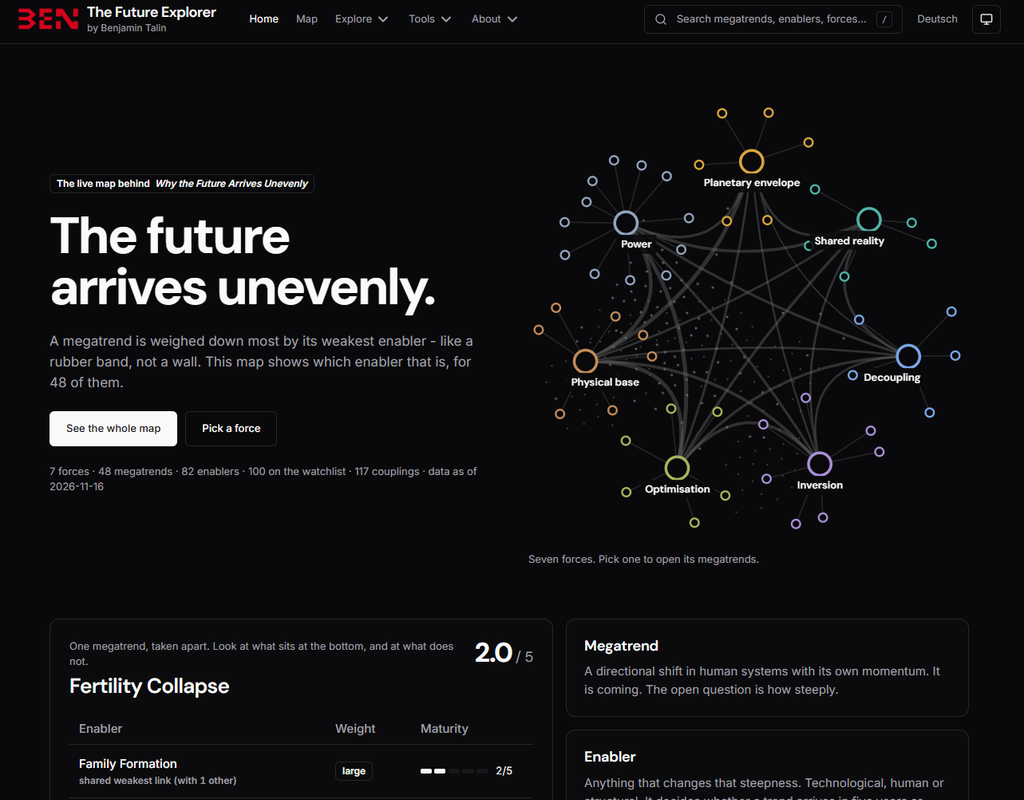
It started with a simple request from the government: write us a little handbook. Almost five years later, it has become an interactive platform that allows users to experience my thought process first-hand. As a futurist and strategic foresight expert, I should help governments understand the future and explain it to politicians and others, but things went in a completely different direction.
"Sure, that's easy"
It began with a request. A government asked me to write a small booklet for their parliamentarians and politicians. They wanted a handbook that explains what is happening with the future, how it works, and how the technologies shaping our society fit together. The brief was 100 to 150 content pages at most, which would come to roughly 50 printed pages.
I said what you say when you think you know your subject: "Sure, that's easy. Let me put a few things together."
That was the start of a rabbit hole that went DEEP.
The privilege of learning in public rooms
Some context on why this was harder than it sounded. Last week I advised my 25th government, and the number keeps growing (actually faster than expected as I still dont do marketing or actively engage anyone). I have now advised roughly 80% of the G20 nations on economic development, on growing economies, on preparing society for change, on proactive research management and on building innovation ecosystems.
That means I sit in many rooms with many smart people. Countries tell me what they are doing, what works and what doesn't. They also bring me very big questions: How do you digitally transform a whole economy? How do you build transition pathways for industries? How do you upskill millions of people? How do you repair a system that is broken? (You know - all the little questions you ask yourself every day)
I like to joke that I'm just like a bad LLM. Everyone is training me, and then I hallucinate the answers together to then answer. The joke is mostly true in the first half. I learn from an unusual number of people, and I was being paid to do it. That is a privilege, and it was the raw material for the book.
When the book became a behemoth
I wanted to get it right as I honestly also felt super honored. I didn't want to mislead anyone and it was the first request ever from a GOVERNMENT to help them understand the future and I also somehow had the image of being responsible to tell people the best version as they were the ones who make decisions that affect millions of lives.
So I kept collecting a LOT. The material grew to about 90 pages of facts alone, drawn from roughly 200 documents. It became almost paralysing. Every time I tried to put it into order, something else needed to be explained first, and something else needed to be explained before that.
One part of the book also refused to fit into the big storyline. I could not find the framework that would hold it together as several parts needed my own frameworks on how people can better understand it. I tried for a long time. Then, one day, I was explaining it to someone on a call, and halfway through a sentence I realised I had just worked it out. I said, "I need to leave this call for a moment. I have to write this down."
That was the missing link: a way to connect change gradients and technology steepness with the different horizons of adoption. A technology doesn't matter only because it exists. It matters because of how steeply it develops, how strongly it pushes on everything around it, and on which horizon it actually arrives in society. Once I could see that, the rest of the book fell into place.
Even then, the finished book would have run to about 900 printed pages. You cannot hand someone 900 pages and call it a handbook.
Splitting it into two
I brainstormed with AI about what to do with this pile of material and my first drafts. The answer was to split it into two books:
- The first book sets out the foundations: how the future arrives and why it arrives unevenly.
- The second book is the guide. It should cover the megatrends, the technologies that drive them, and how those technologies change a trend's trajectory.
The second book is useful to read - no doubt - but its more like a encyclopedia. But I noticed a problem. Reading about trends one by one doesn't give you the big picture and that is where most people struggle as they cant build a mental map.
The map in my head
For me, everything is a data point and everything is connected and it seems to be strange - at least according to my ex-girlfriend who didnt understany why I look around the room to remember things. I picture information floating around - a map, a big graph, whatever - it just connects. And my mind keeps wandering through it and everything around me has some kind of information attached. I see a car drive past and the questions begin. What are the sales behind it? Where was it made? What does it do to the environment, to the grid, to the infrastructure? Why was the infrastructure designed that way, and finally i always ask myself how could it be designed better? Its exhausting and annoying sometimes but seems I found now a profession where its quite useful.
So my life is about solving an endless maze of questions and answers. That is also how I look at economies, at technologies, at trends, at people etc. - everything is just an "Input - Throughput - Output - Feedback-Loop". I'm aware it may be unusual to spend most of the day with connecting some kind of useful and often usless informatin. But it is exactly what I draw on when a government asks me how to prepare for what's coming or how I became good at solving larger systems-scale problems and why things like "First Principle Thinking" is kinda natural to me.
So - doing what I am always doing - I asked myself: why not turn the whole book into something you can explore, instead of something you only read?
Building it: dictation, AI and several weeks
I built the Future Explorer over several weeks, after almost five years of collecting - just the sheer amount of information and data waa a challenge. I dictated constantly - when I was in a bus, when I was traveling, at least giving a "little keynote" was easier than writing it down. And yes ... also AI interviewed me. It asked the questions I should be asking myself, pulled the information out of my head, and helped me research and check the details. Doing this alone would have been a monstrous task.
The result is a platform where you can:
- See how topics connect. Every link and reference is visible.
- See what accelerates and what dampens. Some topics reinforce a trend; others slow it down.
- Follow the cascade. If you change one thing, you can see which follow-on changes to expect.
Why I'm releasing it now
I could have waited for the book. Instead I decided: it's ready, and it's useful now. I will improve it with feedback and its just how I am - I guess after the glooming success of MoreThanDigital to become one of the biggest business plublications in the world helping millions getting access to information - it should be obvious that I care about giving people access to knowledge and the future.
I don't know of any other explorer like it as I couldnt find also anything to "copy from". The first futurists or strategic foresight experts who have seen it tell me it's a great tool, because all the links and references are right there and you can even see where the data is coming from but especially important you can also download the data. For policy creation, for government discussions, corporate strategic management and of course strategic foresight, I think it is one of the simplest and most powerful tools there is and I hope that it keeps growing. I built it for politicians, for C-level executives, and for anyone whose decisions depend on understanding where things are going to be playful and exciting and not just dull like a 400 pages book.
And yeah - its not perfect, it isn't finished, and I want it to keep growing with time (and when I find more time). If you spot a missing link, a wrong connection or a topic that should be in there, tell me. If you have an idea how to make it even better - happy to reach out to me.
So now - Walk through my brain
Almost five years later, you can walk through how I think and see how the world connects - go to the Explore the Future Explorer →